
Consultations shaping better mental health experiences for Tasmanians
Posted on January 29, 2026
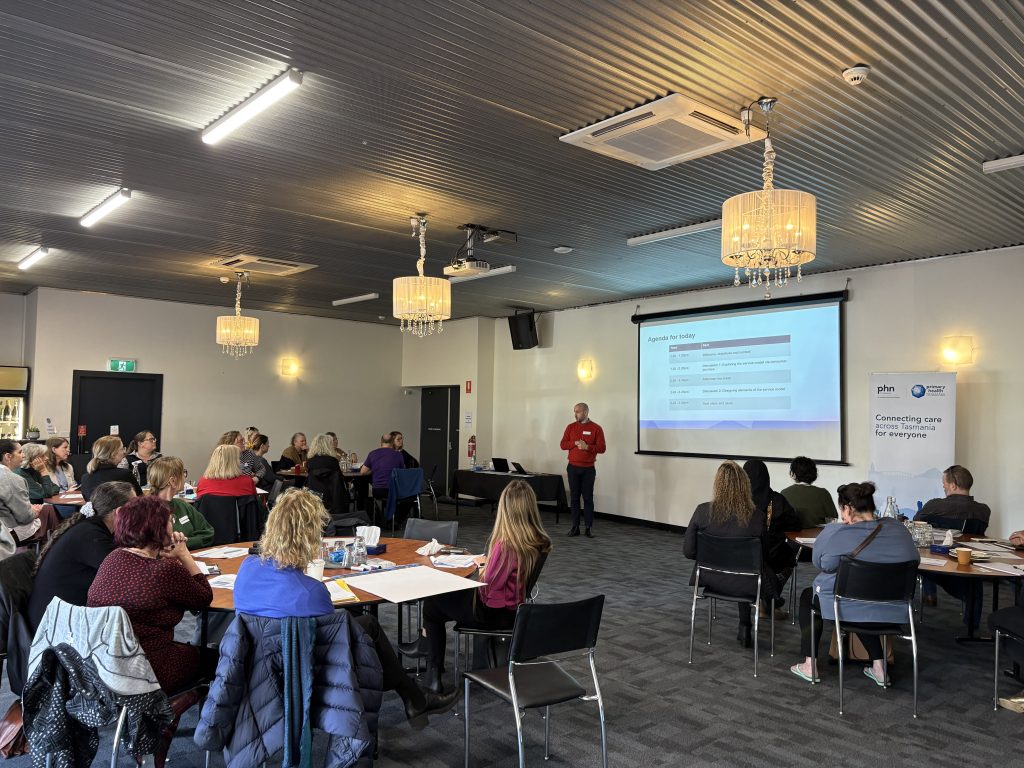
How consultation is shaping better mental health experiences and outcomes for Tasmanians.
When dozens of Tasmanians gathered across the state in July to share their experiences working in mental health services, one thing quickly became clear.
People wanted to be heard, and they wanted to help make things better.
For Brad Smith, a team leader at Anglicare, the consultations were a positive experience.
“It was good to bring together some of these sort of siloed workforces that are operating in their own areas,” he says. “You might be doing a similar sort of role to someone else in the community, but you don’t necessarily have a lot of interaction. So it was quite a good experience to get together, put some faces to names, and just be able to give that input.”
The sessions formed part of Primary Health Tasmania’s Mental Health Continuum of Care Project, a multi‑year initiative to improve Tasmanians’ experience of and outcomes from the mental health services the organisation commissions.
The project involves gathering information and feedback about the current service model to help inform a new service model focused on improved coordination and integration.
Its first stage involved an internal evaluation of four types of services—low intensity services, short-term trauma counselling, short‑term psychological interventions, and services for adults with complex and severe mental illness.
The next phase, which ran throughout July, was about listening.
Primary Health Tasmania, supported by Scyne Advisory, held three in-person and two virtual consultation sessions with 89 participants representing service providers, healthcare professionals, consumers, carers, and people with lived experience.
Together, they explored what makes a good consumer experience, and what principles should shape the new service model.
Feedback from the sessions was overwhelmingly positive.
Every participant said they felt they had been able to provide input, and that their experiences had been heard and captured. Many described the process as “interactive”, “hopeful”, and “well facilitated”.
Kristy Mayne, outreach manager at Rural Alive and Well, says she decided to attend because she wanted to make sure rural voices were part of the discussion.
“I heard about it and thought, I think I actually have some value to add there,” she says. “I wanted to ensure that rural voices were heard and seen, and especially from a program that’s grassroots, that’s non-clinical, that’s out there and touches all parts of Tasmania.”
Kristy says the session provided an important opportunity to advocate for the people her program supports.
“I was able to express and advocate my knowledge and skills on the topics that were relevant to my field,” she says. “It was also great to network to see who’s who in the zoo, who’s doing what, and to make sure we’re not forgotten in future planning around mental health.”
Across the five workshops, participants shared a range of ideas and experiences and some common themes emerged.
The need for more integrated services, clear referral pathways, and effective collaboration was echoed in every conversation.
“There was a lot of agreement,” Kristy says.
“I think a lot of Tasmanians are on the same page, it’s just about how we get it to work where all people are represented and validated.”
For Brad, the workshops were also a chance to hear firsthand how others are grappling with similar challenges.
“Some of the things we’ve been saying internally, it’s good to hear that being echoed more broadly,” he says. “You realise you’re not the only one facing those same system issues.”
Brad says the conversations confirmed what many in the sector already know: Tasmania’s mental health system is highly fragmented, and integration remains a challenge.
“There’s a disconnect between acute care teams, inpatient units, and community support,” he says. “A lot of the integration that happens is relational—it’s people literally knocking on doors, saying, ‘Hey, we’re here, we do this, you can trust us’.”
Brad hopes the new continuum of care model will make those connections easier and more consistent.
“It feels like services are sometimes backwards-engineered—people are doing similar things, but it’s not always clear who does what,” he says. “Having a clearly delineated system would help prompt more collaboration, instead of everyone working in their own silo.”
Kristy says her biggest concern is how long it can take for people to get into services.
“Sometimes we’re the first person someone’s told that they’ve recently had a suicide attempt or been impacted by suicide. We’re usually that trusted person,” she says.
But non-clinical programs like Rural Alive and Well can be left “holding people” longer than intended while waiting for clinical care to start.
“When someone shares something and they’re vulnerable, they want action now,” she says. “The more they are delayed, the harder it gets.”
Both Kristy and Brad say the consultations offered an encouraging sense of momentum.
“It was good to hear about what the next steps were,” Brad says. “The process felt pragmatic and transparent—not just a talkfest.”
For Kristy, it was a reminder of how much potential there is when services, providers, and community members work together.
“It’s not about our egos,” she says. “It’s about getting people the best service and knowing they can come in at any part of that continuum, jump off, jump on, and still be supported.”
For participants, the consultation sessions have already made a difference—not only in what they produced, but in how they brought people together.
“Sometimes it’s just good to be in the same room,” Brad says. “You realise we’re all trying to do the same thing, and that’s to make sure Tasmanians get the support they need.”
Kristy agrees. “We’ve started somewhere,” she says. “We just need to keep going, and make sure the people in our communities stay at the centre of it all.”
Brad concurs. “It’s not just another meeting. It feels like the start of something that could really shift how we work together for Tasmanians’ mental health.”
About the Mental Health Continuum of Care
Primary Health Tasmania’s Mental Health Continuum of Care project is a multi-year initiative to improve Tasmanians’ experience of and outcomes from mental health services. It aims to replace the current fragmented system with a more coordinated and integrated model, ensuring people can access the right support at the right time.
Next stages
- Finalise the new service model based on stakeholder feedback.
- Procurement process: Early 2026 to select service providers.
- Transition period: July 2026 – January 2027 (seven months to ensure continuity of care).
- Full implementation: January 2027.
Our commitment
Primary Health Tasmania will work closely with current and future providers throughout the transition to support service continuity and a safe, planned approach to change.
Learn more here.
This story features in Issue 21 of our Primary Health Matters magazine. Click here to read the rest of the issue.